BreakingFirst at OSC
Just Days After Stitt’s Order – Video Shows Oklahoma Library Officials Discussing How to Weave Diversity Into Everyday Programming
Recently obtained by OSC, a recording made less than a month after Oklahoma Gov. Kevin Stitt’s executive order on diversity shows Oklahoma library officials strategizing about embedding diversity throughout library services.
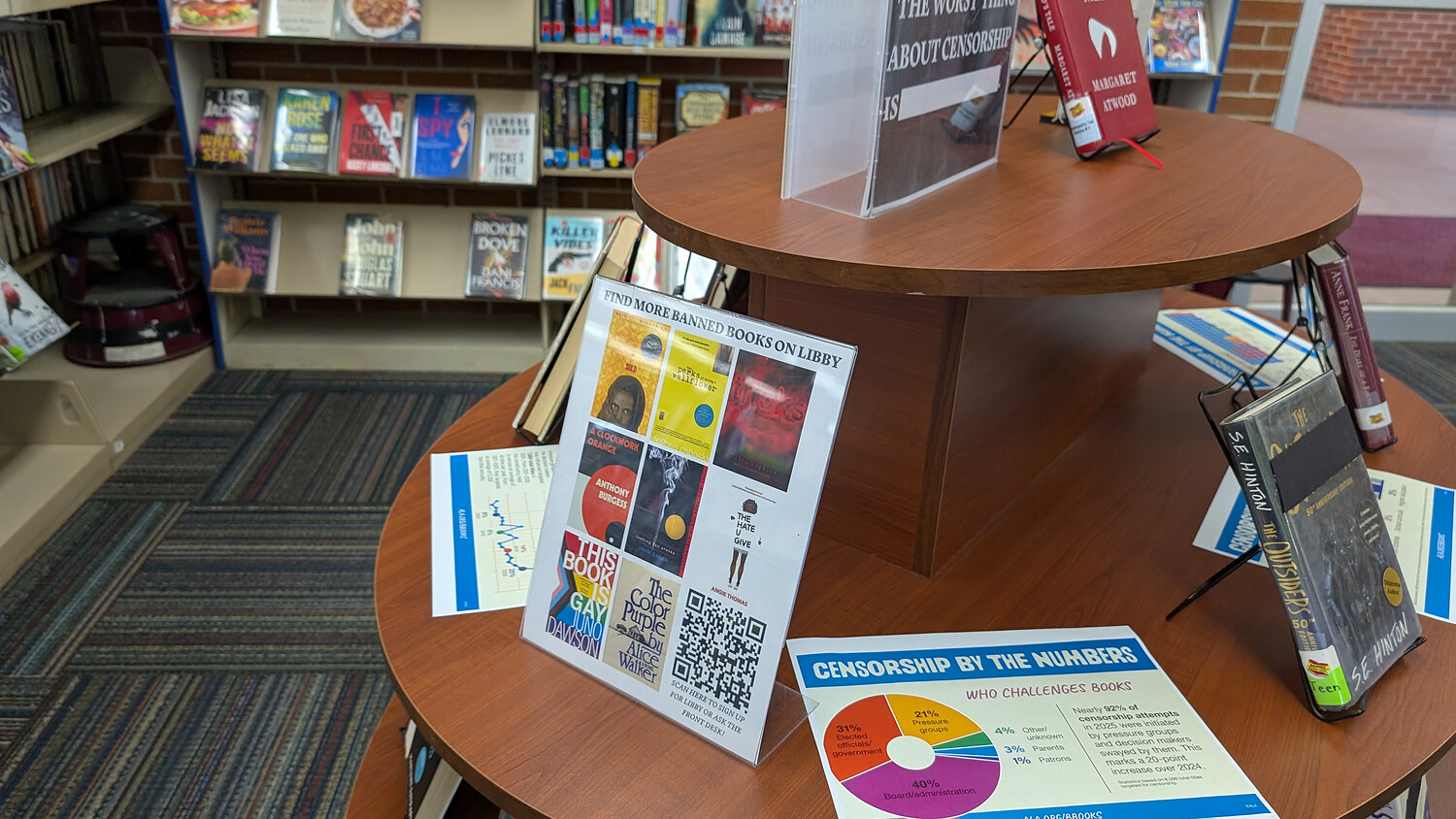
GUTHRIE, Okla. — (October 7, 2026) A “Banned Books” display at the Guthrie Public Library directs patrons to download controversial titles as e-books through the library’s Libby service.
Listen to this article
OSC has obtained video showing Oklahoma library officials discussing how to weave diversity into everyday programming, from book displays and reading recommendations to hands-on workshops. The Oklahoma Library Association webinar took place less than a month after Gov. Kevin Stitt issued an executive order restricting certain diversity, equity and inclusion (DEI) practices.
The Jan. 11, 2024, session, “More than a Month: Celebrating Diversity Year-Round,” included University of Central Oklahoma librarian Karl Siewert, who identified as UCO’s emerging and immersive technology librarian.
Asked about potential controversy over “queering library displays,” Siewert said a Pride Month display “is going to be a target” for objections.
Siewert suggested including queer books and characters in displays organized around more general themes, while qualifying the advice: “I’m not saying that you shouldn’t create a pride display.”
“I don’t want to say flying under the radar necessarily,” Siewert said, “but that’s going to be a much safer way, I think, to handle that kind of situation.”
Siewert described using themes such as red and green book covers or titles beginning with “The City of” to build displays that also introduce readers to unfamiliar experiences.
Siewert also advised librarians to work with administrators and leaders on policies that anticipate objections rather than responding only after problems arise.
The advice extended beyond book displays. Siewert offered a “Pocket Party” sewing workshop as an example of extending diversity programming into makerspaces, which provide equipment for hands-on projects.
Siewert said the program addressed the “pocket parity problem” between clothing designed for men and women, combining a presentation on pocket history with a sewing activity and a discussion of differences in clothing.
“As a person who wears clothing designed for men and clothing designed for women,” Siewert said, “clothing designed for women has deficient pockets.”
Participants sewed historical pockets that could be worn inside or outside clothing and could bring garments to discuss adding or enlarging pockets, Siewert said. Attendance was lower than Siewert had hoped, but the librarian described the program as “fun.”
“Make sure you’re including those in your programming as well and considering diverse perspectives in the things you do in your maker spaces,” Siewert said.
UCO advertised Pocket Party workshops for Oct. 3, 2023, and Dec. 5, 2023, at its Max Chambers Library Innovation Studio. The university notices described learning about pocket history and using the studio’s sewing machine to upgrade clothing. The December workshop was limited to 15 registrants, with students given priority.
Both advertised workshop dates preceded Stitt’s Dec. 13, 2023, executive order. The OLA webinar took place 29 days after the order was issued.
Executive Order 2023-31 directed executive state agencies, including institutions of higher education, to review DEI functions. It restricted state-resource support for programs granting specified preferences and prohibited mandates involving ideological agreement or pronoun disclosure.
UCO was already discussing implementation. Minutes of its Jan. 9, 2024, Staff Senate meeting, two days before the webinar, report that the university’s Committee on Diversity had met with a university legal counsel representative about the order and an expected report on DEI spending.
The order required full compliance as soon as practicable, no later than May 31, 2024. It also preserved constitutionally protected speech and specified exceptions for academic instruction, research, creative work and other activities.
The discussion later turned to state politics. Referring to a chat comment, one participant alleged that state-level leadership was suppressing diverse opinions, voices and perspectives, predicting a “chilling effect” that would “embolden people who want to censor.”
Sara Martinez, who introduced herself as manager of Tulsa City-County Library’s Nathan Hale branch, discussed making diversity a priority in the system’s Your Next Great Read service, which recommends books based on readers’ surveys.
Martinez said she had advocated including “at least one author of color” and a “non-traditional book” in responses, along with possibilities such as a debut author or a science fiction writer of color.
She also encouraged librarians to display books by authors of color with the covers facing outward on shelves.
The session ended with participants exchanging personal reading recommendations. Siewert recommended Gideon the Ninth, describing it as “lesbian necromancers in space” and saying the novel had helped Siewert return to reading for pleasure after a slump that began when COVID hit.

Comments
No comments yet. Be the first to weigh in.
Join the conversation
Sign in with your OSC account to comment on this story and reply to other readers.