BreakingFirst at OSC
“Indiscriminate Mass Surveillance!” Oklahoma Federal Judge Rules Flock Search Unconstitutional, Throws Out Evidence
On Thursday, a Tulsa federal judge barred evidence from a vehicle search that reportedly uncovered 91 pounds of methamphetamine after the use of Flock scan data.
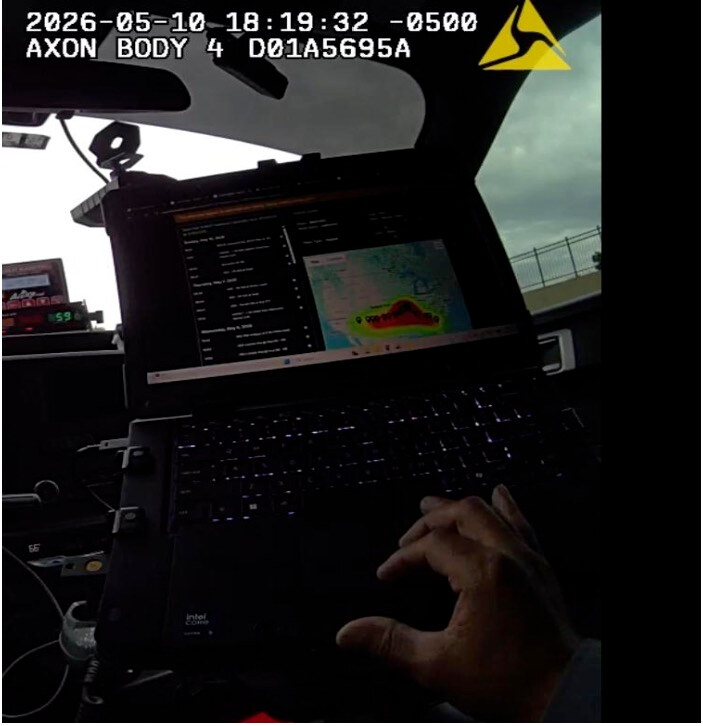
An image included in court records appears to show Tulsa County Sheriff’s Deputy Freddie Alaniz querying historical vehicle-location data associated with defendant Melisa Kyle.
Listen to this article
GUTHRIE, Okla. — More than a year after Guthrie ended its contract with Flock Safety, a federal judge in Tulsa has ruled that a Tulsa County deputy’s warrantless search of a driver’s Flock history violated the Fourth Amendment and barred prosecutors from using the resulting evidence—including a reported 91 pounds of methamphetamine discovered during a subsequent vehicle search. In her ruling, U.S. District Judge Sara E. Hill, of the Northern District of Oklahoma, described Flock’s collection of vehicle movements as “indiscriminate mass surveillance.”
Hill’s 38-page opinion found two separate constitutional violations: the warrantless search of a motorist’s historical location information and the deputy’s decision to extend the traffic stop without reasonable suspicion of criminal activity.
In 2023, Guthrie became one of Oklahoma’s first towns to adopt the controversial technology following a unanimous vote. In the discussion he appeared to come to terms with the plan, Ward II Councilman Brian Bothroyd appeared to envision using the technology for conducting a local dragnet, referring to the a hypothetical red Honda, stated, “If you know there’s a red Honda that’s being searched for, you can just search the system for red Hondas and then weed it out potentially by license number or go to all of those residences where that Honda resides if it’s in Guthrie and potentially find your guy or gal.” Guthrie Police Chief Don Sweger appeared to chuckle before confirming Bothroyd’s description: “Right, on the investigative side, correct.”
In 2025, the city discontinued the program, citing cost.
The Sooner Sentinel’s Marven Goodman subsequently documented a delay between cancellation and removal. In correspondence he published, City Clerk/Treasurer Kim Biggs confirmed that the contract was canceled effective Feb. 18, 2025, with no record of a renewal. Goodman reported that the cameras remained in place beyond a scheduled uninstall date before he personally verified their removal later that month.
The program has also been controversial in Edmond, after Goodman discovered that the police department was using the devices along State Highway 66 without approval from the Oklahoma Department of Transportation, and after the department refused to fulfill disclosure requests from the NonDoc political news service.
The most recent ruling arose from a case in which Tulsa County Deputy Freddie Alaniz began following a rented Mazda SUV after seeing its California license plate. The Flock database allowed him to reconstruct defendant Melisa Kyle’s trip from Oklahoma toward the California-Arizona border and back toward Missouri.
After issuing a warning and returning Kyle’s license, Alaniz asked permission to search the SUV. Kyle refused. He then detained her for a drug-dog sniff. The dog alerted, and officers searched the vehicle, reportedly discovering about 91 pounds of methamphetamine.
Hill concluded that the deputy lacked reasonable suspicion to continue detaining Kyle.
Alaniz’ Flock search produced more than 50 records of Kyle’s vehicle movements across an entire month. Judge Hill distinguished that ability from an officer simply observing a vehicle on a public road: “It is a tool that collects information about all vehicles that pass by any network-connected camera at all times, and it serves up the information to law enforcement on demand,” Hill wrote.
The opinion warned that such records could reveal visits to fertility clinics, doctors, lawyers, liquor stores or casinos, along with routine commutes. Hill acknowledged that the technology offers substantial benefits to law enforcement, but found that those benefits do not erase constitutional limits.
“The government cannot go snooping through our personal lives and business without an adequate basis to do so,” she wrote.
Hill acknowledged that other federal courts, including courts in Oklahoma, had reached different conclusions about license plate reader searches. She argued that older decisions about tracking movements on public roads must be examined in light of the scale and capabilities of modern networks.
Hill, a former Cherokee Nation attorney general, was appointed to the federal bench by President Joe Biden. Her nomination received support from Oklahoma’s Republican U.S. senators, James Lankford and Markwayne Mullin, and state Attorney General Gentner Drummond. Gov. Kevin Stitt opposed her nomination, citing her advocacy for tribal jurisdiction and litigation against the state. The Senate confirmed Hill by a 52–14 vote in December 2023, with Lankford voting in favor and Mullin not voting on final confirmation. She joined the U.S. District Court for the Northern District of Oklahoma in January 2024.
Flock told The Washington Post that it expects an appeal and reversal and disputed the ruling’s consistency with other decisions.
Flock may face an uphill climb in light of recent Supreme Court rulings. Hill’s reasoning drew heavily on two U.S. Supreme Court decisions involving location data: Carpenter v. United States, the 2018 ruling addressing historical cellphone location records, and Chatrie v. United States, the 2026 ruling addressing access to cellphone location history through a geofence warrant. Although license plate readers provide less precise information than cellphones, Hill concluded that reconstructing a month of a driver’s movements implicates the same privacy principles. Her reasoning suggests that the duration, scale and revealing nature of the information collected could become central to future decisions, even when each individual sighting occurs in public.
Hill’s decision follows an earlier Oklahoma state court ruling limiting the use of automated license plate reader evidence. In September 2024, a McClain County district court suppressed license plate tracking data, finding that its use exceeded the purposes authorized by Oklahoma’s statute governing the technology.
Flock data has played a documented role in several Guthrie and Logan County investigations. In May 2024, Logan County deputies used the system to identify a vehicle linked to the abandonment of approximately 30 cats at Industrial Road and Bachus Road, leading investigators to Brook, Jason and Keegan Wanzer. All three were subsequently charged with animal cruelty, abandonment and conspiracy. Deputies also used Guthrie’s Flock system to identify the pickup and license plate associated with a road-rage shooting on State Highway 33, leading them to Jon Michael Sinon. Guthrie police separately credited the cameras with identifying a downtown hit-and-run suspect and generating alerts that helped officers recover stolen vehicles.
Those investigations illustrate the potential stakes if courts extend Hill’s reasoning to other searches of stored vehicle-location data. The cat-abandonment and road-rage cases are particularly relevant because investigators used previously collected camera records to identify vehicles and locate suspects.

Comments
No comments yet. Be the first to weigh in.
Join the conversation
Sign in with your OSC account to comment on this story and reply to other readers.