BreakingFirst at OSC
Robert Franklin’s OU Teaching Role Raises Questions About University’s Political-Candidacy Policy
State payroll records show the Republican nominee receiving OU salary payments during his campaign, raising questions about a longstanding policy requiring employees seeking state office to resign or take approved unpaid leave.
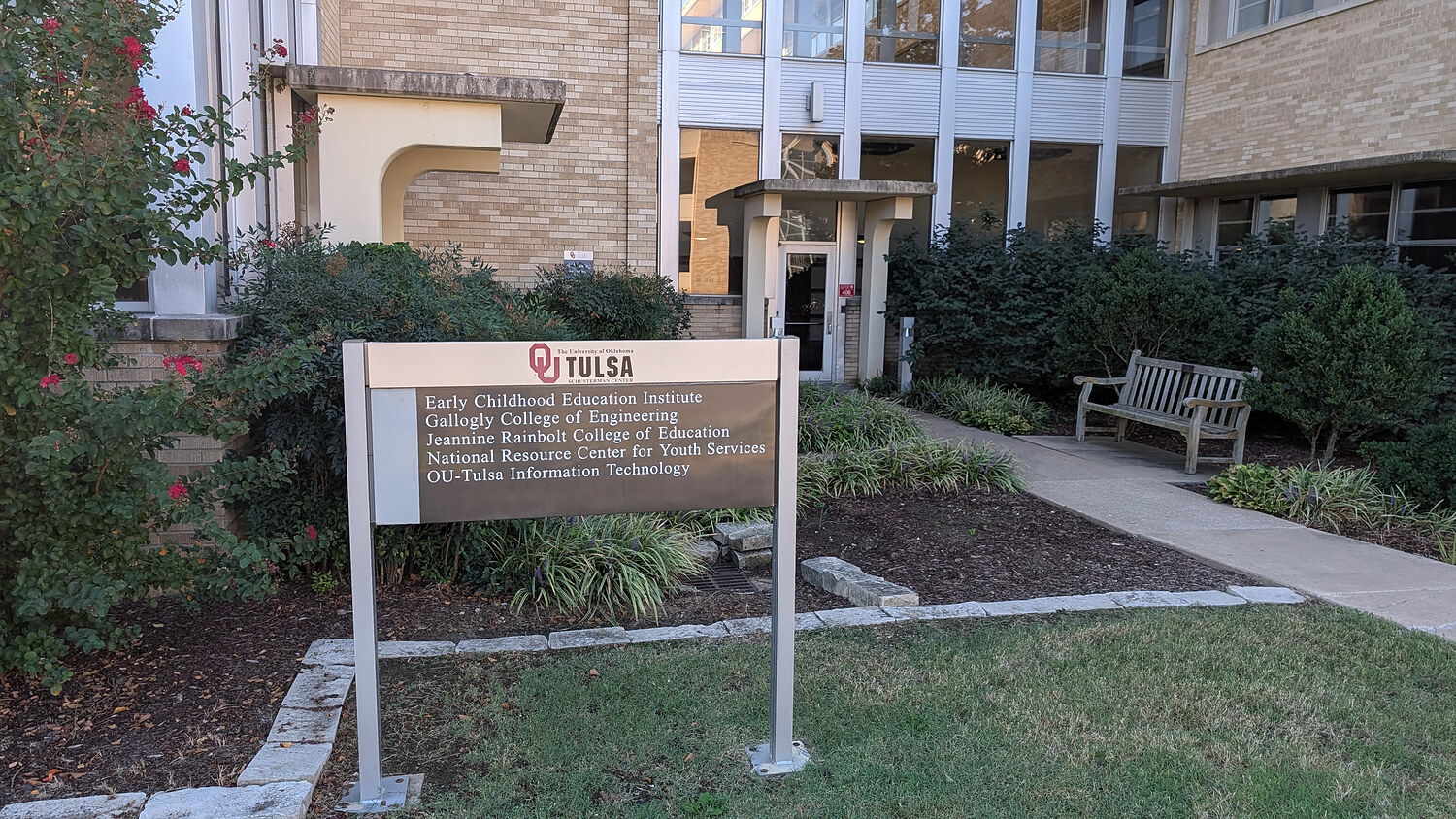
TULSA, Okla. — (October 6, 2026) A sign identifies the Jeannine Rainbolt College of Education at OU–Tulsa’s Schusterman Center, where Robert Franklin has taught in the Educational Administration, Curriculum and Supervision program. Franklin’s continued teaching during his campaign for state superintendent has raised questions about the university’s policy requiring employees seeking state office to resign or obtain approved unpaid leave.
Listen to this article
More than six decades after University of Oklahoma President George Cross told legendary football coach Bud Wilkinson that he could not run for Oklahoma’s governor’s seat while remaining a university employee, OU’s longstanding restriction is potentially facing another test.
Robert Franklin, the Republican nominee for state superintendent of education, announced his campaign in March while working as a part-time adjunct faculty member at OU, continued in that role into May and reappeared on the university’s September course schedule—raising questions about how OU applies its political-candidacy policy to part-time faculty and, in particular, to Franklin, whose first-place Republican primary finish in June elevated him to statewide prominence.
At issue is a university policy dating back to 1943 requiring “any employee” of the university to either resign or receive approval from a “Candidacy Review Committee” to take an unpaid leave of absence upon becoming a candidate for state office.
Franklin, in a Friday email to The Capital, stated that he notified university officials prior to campaigning for office, acknowledged working for the university as a contracted part-time lecturer in April and part of May, and indicated that, if elected, he would resign from his part-time position at the university.
Also corresponding with The Capital, university officials confirmed that “OU’s policy applies to all individuals who are employed by the University,” but did not elaborate on the specifics of Franklin’s case.
State payroll records list payments from OU to Franklin through May and again in September, with payment dates as recent as September 18. OU’s fall course schedule lists Franklin as the instructor for “Ethics in Education Administration,” with nine students enrolled in a class with a capacity of 20.
The university reports Franklin’s compensation as “Salary” through the state’s payroll datasets, described by the Office of Management and Enterprise Services as representing “the amount paid to an employee during the reported time period.”
If elected state superintendent of public instruction, Franklin will lead the agency responsible for administering state and federal education funding and implementing an extensive framework of laws, policies, administrative rules and federal grant requirements affecting nearly 700,000 Oklahoma public school students.
The university’s prohibition has a storied history in Oklahoma politics, effectively preventing university employees from running for office since 1943, including an iconic figure of Oklahoma political lore: Coach Bud Wilkinson. As described by former University of Oklahoma President George Cross in his book, Presidents Can’t Punt, Wilkinson was approached by a university regent close to then-Gov. Howard Edmondson and asked to run for governor. Wilkinson consulted Cross, who reportedly told Wilkinson that it would be impossible to run because of the policy. Cross said Wilkinson agreed and believed that it “should not be possible” for him to run.
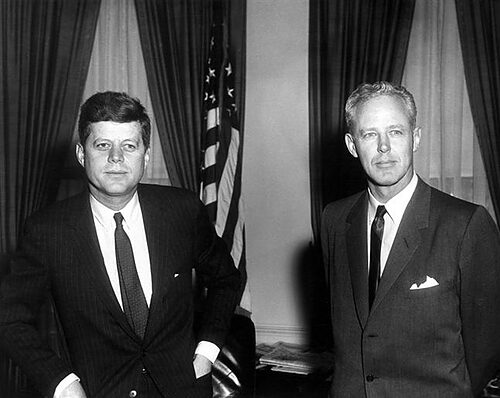
President John F. Kennedy, left, meets with University of Oklahoma football coach Bud Wilkinson in the Oval Office on March 23, 1961. Ahead of Oklahoma’s 1962 governor’s race, Gov. J. Howard Edmondson, one of Kennedy’s few prominent allies among Oklahoma’s Democratic leadership, backed efforts to recruit Wilkinson as a candidate. OU President George Cross maintained that university policy would require Wilkinson to resign if he sought major public office.
In 1950, Cross had asked the Regents to approve the dismissal of the longtime dean of the Pharmacy College, who had failed to resign when running for the state senate. The Regents subsequently accepted Cross’s recommendation.
The University of Oklahoma Board of Regents amended the policy in 2018, after 10-year employee Breea Clark was forced to choose between campaigning for State House District 45 and giving up her university employment. The Regents relaxed the provision, allowing employees to take an approved unpaid leave of absence during their candidacy rather than requiring outright resignation. The amendment also established a Candidacy Review Committee to evaluate the leave requests.
Franklin entered the crowded Republican field of candidates in March 2026. At the time, Franklin described his role with OU as that of an “adjunct” in an interview with Tulsa’s Fox 23. He was considered largely unknown to the wider public, challenging a group of established politicians and previous candidates for office. He ultimately emerged with the nomination after defeating James Taylor in the August Republican primary.
Voters will decide between Franklin and Democratic nominee Jennettie Marshall in November’s general election.


Comments
No comments yet. Be the first to weigh in.
Join the conversation
Sign in with your OSC account to comment on this story and reply to other readers.