Nearly Three in Four Oklahoma Driver’s License Offices Have Been Exempted From Open Hours Requirement
An Oklahoma state law requiring Oklahoma's tag agencies to stay open outside of normal business hours, providing access to those who can’t get off work, has been riddled with exemptions according to a just-released state report.
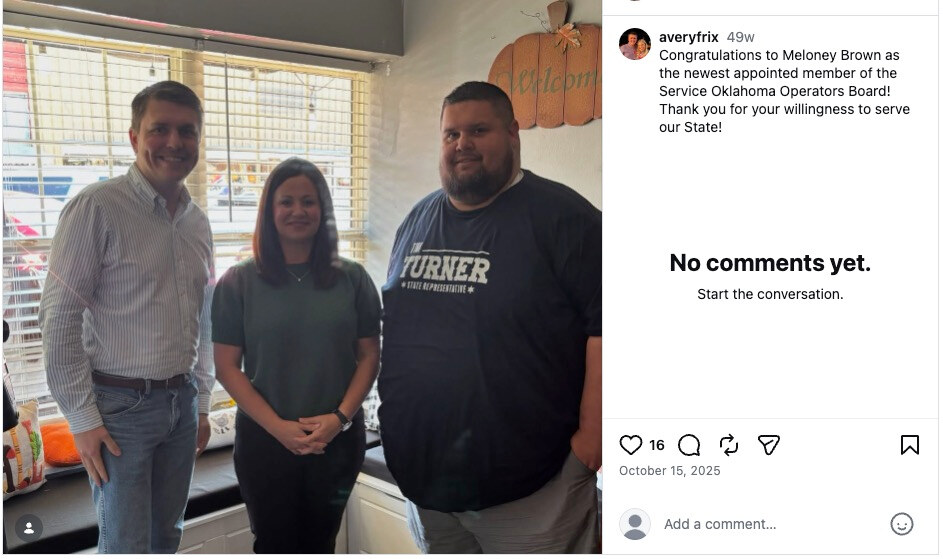
In an Oct. 15, 2025, post, state Sen. Avery Frix joins state Rep. Tim Turner in welcoming Checotah licensed operator Meloney Brown to the Service Oklahoma Operator Board. Brown later supported granting 22 new exemptions from the state’s operating-hours requirements for licensed operators.
Listen to this article
Nearly three out of four of Oklahoma’s privately operated licensing offices have received exemptions from a state law requiring them to operate at least 40 hours a week, including four hours outside normal business hours or on Saturday. Meanwhile, the state agency charged with overseeing compliance with operating hours had not routinely checked whether operators followed even their approved schedules.
A just-released report from the Legislative Office of Fiscal Transparency (LOFT) found that 168 of Oklahoma’s 234 Licensed Operators, (formally known as tag agents) or about 72%, have an approved deviation from the state law’s requirements.
LOFT recently brought the issue to a committee of legislators, citing complaints from residents who encountered offices that closed early, stopped processing credentials before the end of the business day or advertised hours that did not match their actual availability.
Service Oklahoma Chief Executive Officer Jay Doyle told lawmakers that four members of his agency’s nine-member governing board are Licensed Operators. This is despite the fact that state law requires only two, effectively doubling the required representation of Licensed Operators on the board that approves the exemptions.
LOFT also documented instances in which credential services were unavailable even during an operator’s reported business hours. At one unnamed location visited by LOFT, a posted notice said credentials would not be processed between 12:30 and 2 p.m. and that processing ended at 4:30 each afternoon. Service Oklahoma’s records listed that location’s longer hours—9 a.m. to 5:30 p.m. Monday through Wednesday and 9 a.m. to 5 p.m. Thursday and Friday. LOFT calculated that the discrepancy deprived the public of nearly a full business day of credential services each week.
At another location, LOFT staff encountered a sign stating that the “state system” was down and licenses could not be issued. Service Oklahoma later told LOFT that the statewide system was operating at the time. The report also found that some operators depend on a single employee, or very few employees, to process credentials, leaving customers unable to obtain licenses when those employees are absent. LOFT said such arrangements can violate contract language requiring sufficient staffing and contribute to delays and inconsistent access.
The finding appears to complicate the promise behind Service Oklahoma’s creation. The state established the agency in 2022 with a goal of a more consistent service after years of long waits and problems implementing REAL ID. The operation grew from 250 transferred employees to 427 employees by March 2026, even as the majority of privately operated sites continue to hold exemptions from the law’s mandate.
Additionally, the report found that Oklahoma’s fees are the highest in the region and rank 10th nationally, while the number of providers significantly outpaces the number in comparable states.
LOFT’s report recommends giving Service Oklahoma stronger operational authority, improving audits and creating a formal system for operator-specific customer complaints to be submitted to the board.
Doyle indicated the agency would adjust to the report’s findings and expand its auditing process to check for compliance with the operating-hours requirements.
However, Doyle suggested Service Oklahoma had inherited the exemptions when it took over administration of licensing from the Oklahoma Tax Commission.
In his comments to the legislative oversight committee, Doyle seemed to suggest that the members of the Service Oklahoma board, including its four operators, were responsible for the exemptions, without reminding legislators that he himself is a member of that board.
A review of the Service Oklahoma minutes, suggests Doyle has been complicit in the expansion of the exemptions. In 2025, Doyle board designee Diedra O’Neil was shown to be in support of making the exemptions permanent, thus ending the need for the exemptions to be renewed on a yearly basis.
In 2026, Doyle supported expanding the exemption schedule to include 22 additional operators, including one in Logan County, the county’s third exempt tag agency.
The LOFT report, delivered a few months after its expected February 2026 publication date, is the fifth report produced by the agency in 2026. The agency has produced 42 reports since releasing its first report in January 2021. Twelve of those reports were released in 2021, the agency’s first full calendar year.
Only one report appears to remain in the agency’s publicly posted release pipeline for 2026: a review of the Oklahoma State Fire Marshal’s Office that is running significantly behind its scheduled March 2026 release date.
The agency does not implement its savings recommendations; it is simply authorized to make them. Nor does it appear that a report has been published showing the actual savings or new efficiencies resulting from adoption of LOFT recommendations.
There also appears to be legislative resistance to acting on the findings of the latest Service Oklahoma report.
The report’s observations about the high cost of licensing in Oklahoma drew forceful pushback from the oversight committee’s co-chairman, Rep. Trey Caldwell, R-Lawton, who argued that the comparison between state offices and private operators was “comparing apples to oranges.” State locations primarily handle credentials, Caldwell said, while Licensed Operators also process vehicle registrations, titles and other transactions. He claimed credentialing represents only “about 10 or 15 percent” of their work and warned against turning the report into a case for eliminating private locations.
Caldwell cited personal experience to defend the private network, saying he had never waited more than five minutes at a tag agency and describing much shorter waits in southwestern Oklahoma than those reported for state offices. He declared that, although he had had “tens of thousands” of communications with constituents, no one had expressed concern about the cost of fees compared with those in other states “4,000 miles away.”

Comments
No comments yet. Be the first to weigh in.
Join the conversation
Sign in with your OSC account to comment on this story and reply to other readers.