OPINION: Scorekeeping, Revenge, and Non-Citizen Commercial Drivers Licenses in the Oklahoma House of Representatives.
How one legislator’s fixation on scorekeeping led him to take credit for non-citizen commercial driver’s licenses — an epic self-own.
Listen to this article
It’s one of the most important pieces of advice on the legislator checklist: don’t keep score, and never retaliate.
One member of the House apparently never got this memo. By keeping score — and appearing to retaliate — he put himself on the line for one of the most epic self-owns in the Legislature. And it’s a self-inflicted wound that just keeps getting worse each time a non-citizen, driving with a commercial driver’s license (CDL), goes viral for putting lives in jeopardy — or worse, as happened in Florida in recent days, an issue that has been highlighted by the Trump administration’s transportation secretary on his X feed as he seeks to respond to a looming public safety disaster.
What is scorekeeping, you may ask?
Scorekeeping takes place when a legislator tracks the identities of those who vote against his proposal.
Keep in mind the following: in today’s House of Representatives, real deliberation rarely occurs in public. The imperial speakership of Charles McCall — which dragged on for a long eight years — and the subsequent speakership of Kyle Hilbert have concentrated real decision-making into the corner offices, far away from public view. Thus, once a bill is brought to the floor for a vote, it’s only to meet the most perfunctory requirements of deliberation. That’s demonstrated by the fact that out of more than 1,000 votes during the last year, approximately 20 proposals faced defeat.
So, casting a vote against a scorekeeper’s proposal — even when the “no” vote comes from a small group of conscientious members — puts that conscientious member at risk. By going against the grain, that conscientious lawmaker ends up on the losing side of the majority, and risks alienating the scorekeeper and facing retaliation. That's a big part of the problem in today's non-deliberative culture of the House: too few members have the courage to take on this risk.
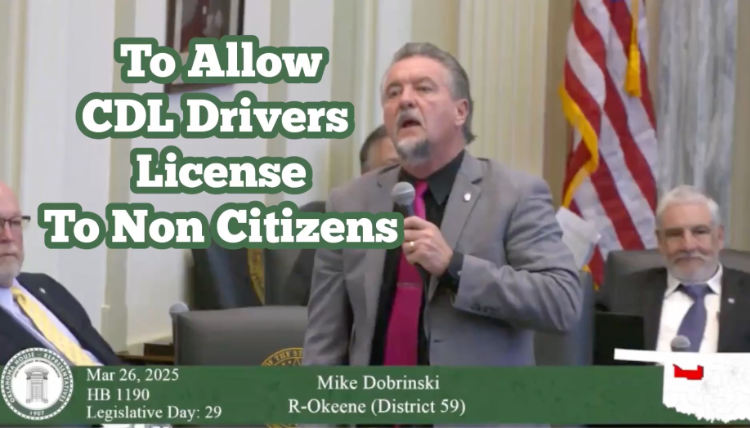
This was vividly demonstrated in March, when one of those scorekeepers took to the floor of the House to make clear to the world that he was, in fact, a vindictive scorekeeper. But in an ironic turn of justice, his ill-advised attack became the case-in-point example of the dangerous and detrimental effect of the petty scorekeeping mindset. He committed an epic self-own, the likes of which are hard to contemplate, demonstrating just how out of touch he — and many members of the Oklahoma House of Representatives — are with the values of the people of Oklahoma.
And, worse, that vindictive approach, to the extent it influenced the other members of the House, put them on the record with a vote that will now require thousands of lobbyist dollars, and the skill set of the state’s best consultants and message massagers, to try to repair.
The vote went down in March, as State Representative Rick West, in conjunction with State Senator David Bullard, brought forward House Bill 1190 — legislation you can read more about in a previous post from this publication — a proposal from one of West's constituents, a retired law enforcement officer, who asked that West take the common-sense proposal of ensuring that before someone is given a badge, gun, hours of taxpayer-sponsored training, and the power of a law enforcement office, they should first take the time to become a citizen of the country — a country whose laws they are expected to enforce.
This is one of the 80-20 policies, which lawmakers would normally quickly sign off on, understanding that 80 percent of their constituency would support the concept of citizenship and its value. But, on that day in March, for some reason only 33 out of the 101 representatives were willing to support the bill, meaning that it failed not just for this year, but next as well.
West's proposal continues to prove prescient, following disclosure this week of the arrest by ICE of a non-citizen, who would later prove to be an illegal alien, who somehow managed to get hired as a reserve police officer in Maine. This is yet another in a continuing line of stories about how blue states are putting badges and bestowing law enforcement power on non-citizens.
How did so many representatives get it backwards, allow Oklahoma to stay in the ranks of the blue states, and go on the record with such an unthinkable vote? What was the mindset in the room that twisted Oklahoma's political class into an upside-down world where allowing non-citizens to arrest and enforce the law on citizens was the right thing to do?
Introducing the victim of the epic self-own: State Representative Mike Dobrinski. He is the state representative for House District 59, a large district of previously serene, beautiful Oklahoma plain/prairie, which has been obliterated, destroyed, by the left’s green energy wind turbine invasion, with the acquiescence of many in Oklahoma state government, including Dobrinski, who voted against the vital Jim Shaw amendment to House Bill 2751 — an amendment that would have started the process for protecting private property rights from that government-subsidized invasion.
As West laid out his proposal to the House, Dobrinski seized the microphone to dredge up a vote from 2023 — pointing out that West had, two whole sessions ago, nonetheless, opposed Dobrinski's Senate Bill 682, a measure that opened the door for a new group of non-citizens to obtain commercial driver’s licenses. How Dobrinski concluded that West’s refusal to hand out CDLs to non-citizens somehow disqualified him from barring those same non-citizens from becoming police officers is anyone’s guess. That "logic" immediately collapses under its own weight.
Those who weren’t trapped in the upside-down climate of the House could immediately see that West was being consistent.
But, in the artificial, upside-down climate of the House, Dobrinski won the day; legislators decided to do something they rarely do: test out the functionality of their red buttons.
But that upside-down, artificial world isn’t the real world. And in the real world, Dobrinski had just committed an epic self-own, publicly admitting to having committed a policy atrocity.
Had Dobrinski been tapped into the grassroots social media zeitgeist, he might have caught what was the beginning of a trend: blue states finding ways to get CDLs into the hands of non-citizens who were subsequently committing safety infractions that threatened the life and safety of citizens.
Having been aware of this iceberg of incoming political liability, perhaps Dobrinski would have realized the wisdom of letting his 2023 policy infraction remain in the past, where perhaps no one would notice.
But Dobrinski was a scorekeeper, and as West came under attack from the leftist Democrats, who for whatever reason seem to first and foremost advocate for the non-citizen, he clearly sensed blood in the water, and decided that this would be the time to let everyone know that West had voted no on his proposal in the past.
And thus the point of the very wise advice to the current and future members of the Legislature.
As the grassroots elect a new generation of legislators — legislators who will take the House of Representatives out of its dark age and begin restoring and healing its culture — and as they devolve the concentrated, behind-the-scenes power back to the members and return the chamber to a more deliberative environment, the legislator must adhere to the following best practice: never look at the vote, unless it is necessary for reconsideration or for future consideration of the same legislation.
There are those who believe that a legislator might forgive, but should never forget. They believe in the philosophy of serving revenge at a future date as some sort of bizarre strategy for ensuring that, in the future, the other legislators will be afraid of the never-forgetting legislator.
As so adeptly demonstrated by the Dobrinski self-own, this is a dangerous mindset.
When another member of the House votes against a proposal, the voters of the district will be the ones to hold that person accountable for their bad vote. But the sponsor of the good proposal, to the extent possible, must not allow the identity of the bad-vote caster to even make its way into the sponsor’s brain. He should become completely unable to remember or recall the identity of the legislators voting against his proposal.
This lack of scorekeeping means retaliation isn’t even possible, and allows the members of the House who vote no on a good proposal one day to become the strongest allies of a good proposal on the next. And thus, when a legislator doesn’t even remember who it was that voted "no," his relationship with the person will allow that voter to quickly pivot and do the right thing on future votes without ever deepening the wound or potential for relationship trauma from the previous vote.
Would you like to see the complete checklist of advice to the new legislators? You can find it here.
And, for those who are interested in taking a deep policy dive into the history of government efficiency and reform in the Oklahoma House of Representatives, during the first generation of majority Republican leadership, you are invited to view a presentation I provided to Senator Bullard as part of his interim study on Monday.
The 30 minute presentation leads off the study, and a copy of the slide deck can be found here.
It’s a deep dive into policy that’s at the heart of what I believe it means to be a conservative — a proper custodian of taxpayer dollars and a roadmap for future conservative governance that will only be possible with the election of grassroots conservatives who are willing to do the hard work to expose and eliminate the many millions of wasteful spending.
Bullard’s invitation had the effect of a time machine: allowing me, a member of the first generation of majority Republicans, to enter into the dark, opaque culture of the current Legislature, and reintroduce unfamiliar terminology that we frequently discussed in years past, but that I suspect is rarely used in the current-day environment: efficiency, reduction of costs, transparency. To talk about the means and methods for achieving those goals — devolving power from the few individuals who control it, returning to a member-driven budget, oversight meetings focused on specific performance metrics, and accountability.
It’s not the most exciting subject matter, but in my view, it’s the most important, and it’s at the heart of the responsibility of any legislator. Bullard’s willingness to allow this discussion, even though it was frequently and specifically indicting of the current legislative leadership, is notable.
Sign up for a free or a paid subscription on Substack to ensure you will see future stories like this one in your email
👉 Subscribe here: by clicking here.


Comments
No comments yet. Be the first to weigh in.
Join the conversation
Sign in with your OSC account to comment on this story and reply to other readers.