BreakingFirst at OSC
In 4–3 Vote, Guthrie Historic Preservation Board Rejects Guthrie Business Owner’s Request for Brick Storefront
In a Victorian vs. Art Deco style debate, Jennifer Bozarth says she will appeal Monday night’s Historical Preservation Board’s ruling to the City Council—giving the council an opportunity to weigh in on the controversial preservation board’s split decision.
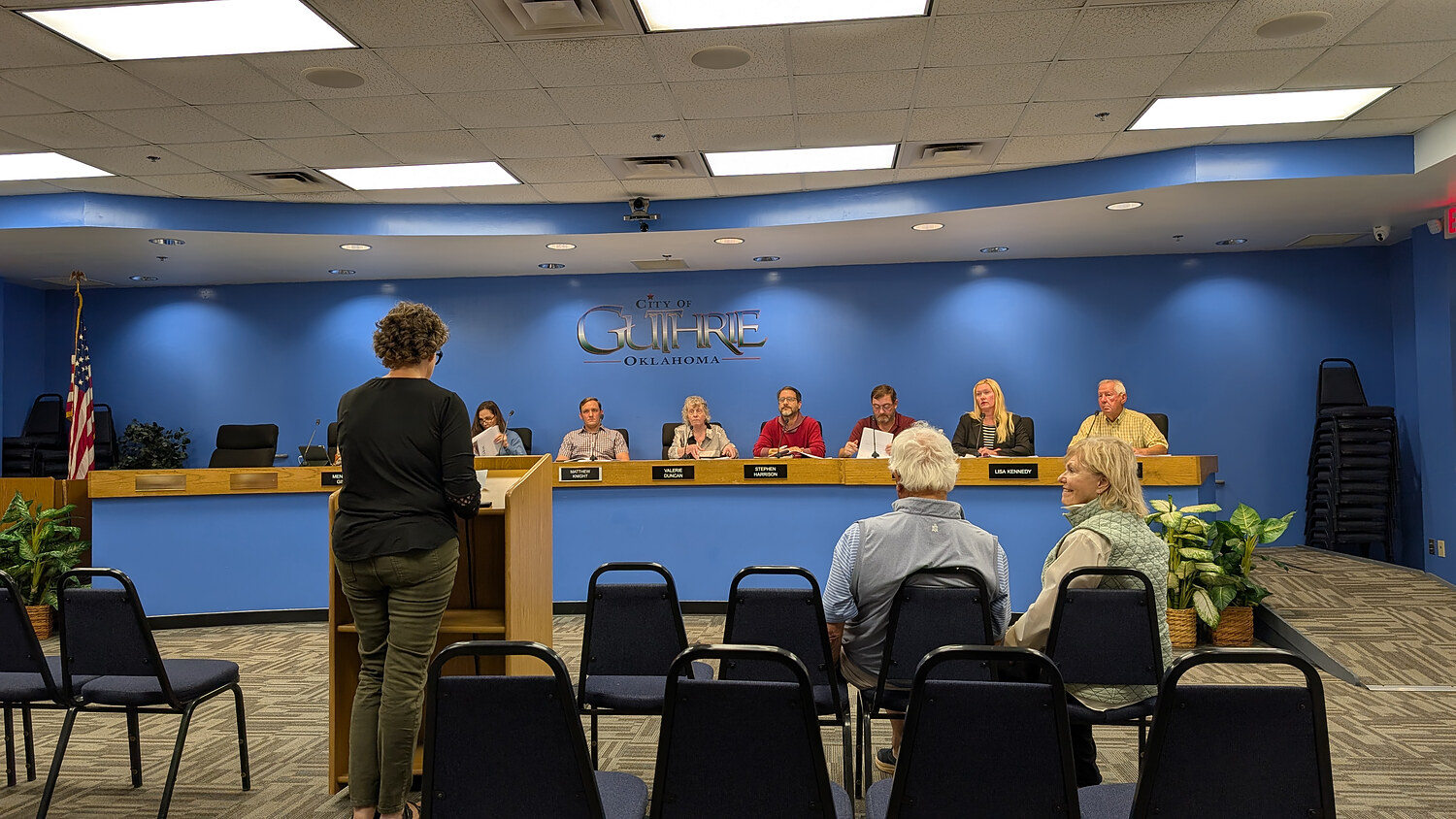
GUTHRIE, Okla. — (November 2, 2026) Local attorney Jeff Hirzel and his wife, Carol, look on as Jennifer Bozarth returns to the Guthrie Historic Preservation Commission to make her case for retaining the brick exterior of the McNulty Building at 220 E. Harrison Ave.
Listen to this article
Guthrie business owner Jennifer Bozarth returned to City Hall on Monday night in her attempt to keep a brick exterior at 220 E. Harrison Ave., the McNulty building.
It was the fourth time the matter had been before the commission since June, after Bozarth set about renovating the building and removing its glass-like, Art Deco-era Vitrolite tile exterior. That decision frustrated commission Chairman Valerie Duncan, who has repeatedly criticized the failure of the city’s business owners to get preapproval for projects affecting building exteriors in the town’s historic district.
Duncan was joined by commission members Lisa Kennedy, Stephen Harrison and the newly appointed Matthew Knight in voting down fellow member Nathan Turner’s motion to allow Bozarth to proceed with her plan to restore and maintain the building’s brick, previously covered by the Vitrolite, as the exterior surface. Members Darrell Covington and Carol McPeek supported Turner’s motion.
Bozarth, joined by family and friends, presented board members with an opinion provided to her by Acme Brick, stating the brick was designed to withstand harsh weather environments.
This opinion contrasted with what board member Lisa Kennedy had previously told Bozarth during the commission’s October meeting. Then, Kennedy told Bozarth the brick wasn’t designed to serve as an exterior surface, declaring it was “basically like sandstone.”
However, commission members remained unable to get past the building’s potential transition away from its original Art Deco style to brick. Carol Hirzel, attending as a member of the public, suggested the brick was much more in line with the commission’s mandate to protect the Victorian architecture dominant during the 1890–1910 pre-statehood and early capital city era than the Art Deco style of the 1920s and 1930s.
At one point, in a back-and-forth exchange with Duncan, Hirzel suggested that if it were her building in question, she would file a case in federal court. This lead Kennedy, to tell Hirzel, that she, Hirzel could, as an alternative, purchase a building that wasn't in the historic district, suggesting the role of the board is to preserve the properties so that the city could get grants.
The question of the commission’s role in the project, which lies at the far eastern edge of the historic district, has remained a consistent issue since the matter first came before the commission in June, when Guthrie city planner Dan Kassik told commission members the property was a noncontributing resource within the district.
Board members have, however, continued to express a strong affinity for the original Art Deco facade, declaring its removal the loss of one of the town’s last remaining Art Deco facades. The commission has given Bozarth the option of either restoring the Vitrolite surface or covering the building in stucco, a surface members have deemed consistent with the Art Deco aesthetic.
Bozarth told the Capital after Monday’s meeting that she plans to appeal the rejection to the City Council.

Comments
No comments yet. Be the first to weigh in.
Join the conversation
Sign in with your OSC account to comment on this story and reply to other readers.