OPINION: Jason Murphey’s Ballot: 2026 General Election
Answering the questions: How are you going to vote on the state questions? Is it OK to vote for a Democrat? What about the judicial retention ballot?
Listen to this article
As of today, one week out from the 2026 general election, my ballot is as follows.
I will be voting for Mazzei, Shannon, Hern, West, and Byrd.
As of now, pursuant to the criteria explained in this article, I will be undervoting the attorney general, insurance commissioner, U.S. House, and corporation commissioner races. One note, in the U.S. House races, if you reside in Congressional District 2, Oklahoma’s best congressman is deserving of your support. The rest are deserving of your undervote.
And I will, for sure, undervote the superintendent of public instruction race.
I will vote for both state questions.
I will vote to reject Darby on the Supreme Court and retain the rest of that court. On the other courts, I will retain those whose last names begin with an H and reject the rest.
Read on for the reasoning.
It’s the type of question that keeps popping up in my correspondence:
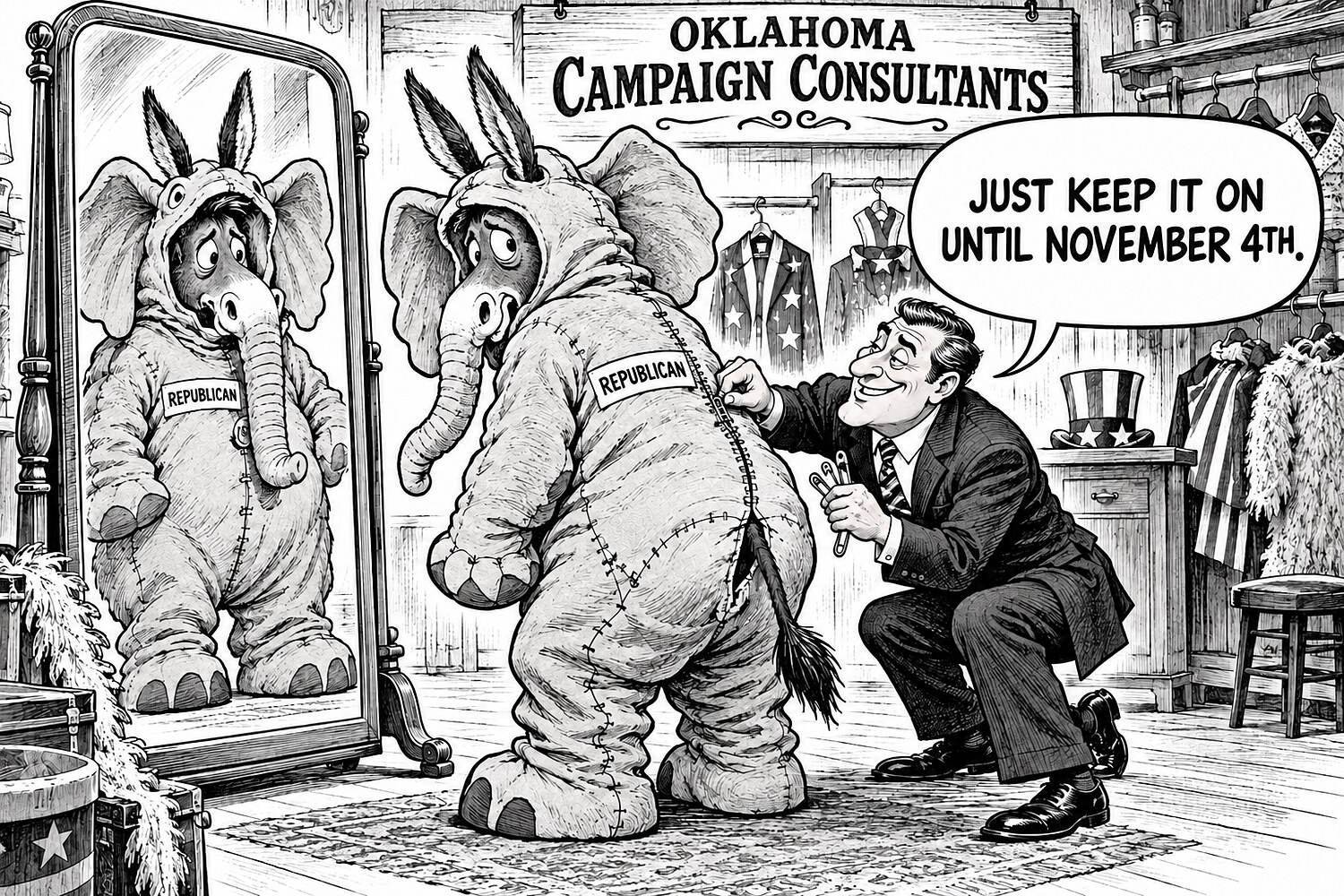
“The Republican nominee for [insert position here] isn’t really a Republican. Why shouldn’t I just vote for the Democrat, who is at least honest enough to admit to those views?”
I very much understand what drives this question. And I have carefully developed a philosophy on this that governs my personal votes. That philosophy is as follows: I will use strategic empathy with my voting pen.
I can never vote Democrat. If nothing else, I can’t do that to the voting pen, which surely must feel great revulsion as it’s forced to fill in the arrow next to the names of those with the very bad judgment to still carry that sick, dying brand of “Democrat,” forever cementing their legacy in American history as betraying the values that built the greatest republic in the history of the world.
In the post-2020 world, the Democrats have either stood by or actively participated in a frontal, all-out, unabashed attack on American culture for their own political gain. That attack has been temporarily stayed to some extent by the Trump administration, but it’s sure to return, probably with even greater intensity, once the pendulum swings—as it always does.
I feel that selecting that name—in my personal opinion—is, in some way, betraying the concept of America itself. I don’t want any part of that.
If we are to preserve the American experiment, we must, as a society, at the very least elect those whose self-preservation interests dictate that they take the views of constitutionally minded Republican voters into account, even if those elected officials are sleazy Republican politicians.
For example: Jon Echols.
It’s the attorney general’s race where Oklahoma’s craftiest politician, Jon Echols, represents the Republican brand, despite having, time and again and with extreme prejudice, violated the most sacrosanct of Republican principles during his time in the Legislature.
During the primary campaign, Echols stood by while his establishment dark-money group conducted what might have been the most heinous, despicable, reputation-destroying dark-money campaign in the history of the state. And he is likely to bring any number of that set of establishment personalities into the attorney general’s office with him.
The thought of voting for Echols rightly seems mighty distasteful to any thoughtful voter. But, unfortunately, one must recognize how much the power of the attorney general’s office has expanded. It’s now its own massive bureaucracy.
If someone takes that office without having to respect the will of the Republican primary electorate in just four years—a future election cycle that will be here before one can blink—there’s a danger. If the pendulum swings to the left in D.C. in 2028, that attorney general will be free to do whatever he can, at least passively, but even actively, to advance D.C.’s agenda for the nation.
However, if the occupant of that office must soon go before the Republican electorate, he will most likely push back, delaying D.C.’s agenda and buying valuable time until the national pendulum swings back again.
Now, this is still a deceptive game. When the “Republican” attorney general is a crafty politician, he will have the skill set to put on a public front while, behind the scenes, doing the bidding of the monied interests. And when the left is in power in D.C., the local monied interests will align with where the money goes. For example, consider the wind-power expansion of the Biden years, pushed by D.C. and destroying rural Oklahoma.
All of that said, Echols is on pace for an easy victory, thus affording those who, like me, can’t lend the credibility of their pen to checking the box next to that sleazy politician’s name — the luxury of simply leaving that item blank.
Thus, the personal philosophy I have implemented throughout the years to guide my personal vote in situations like this comes down to three classifications:
- Where, in my view, the Republican really is a Republican and would be a Republican even if Oklahoma were a blue state, I can cast a vote. Such a candidate has at least some real constitutional republican principles that will guide him to the right place on the big issues and, on the issues where the public isn’t paying attention, enough core principles to push back against the bureaucracy and monied interests, at least some of the time. In this election, I believe these candidates are Mazzei, Shannon, West, Byrd, Hern, and Brecheen (CD2).
- Where the Republican is a politician whose past votes, actions, or choice of associates—establishment consultants and monied interests—prove that the candidate belongs to the sleazy politician class, I will only vote if there is a chance the Democrat could win. Such a candidate represents the best of the bad choices, if for no other reason than having to care about what the Republican electorate thinks in order to win reelection in either two or four years. As of now, due to what is perhaps the weakest Democrat candidate field in the history of the state, the voter has the luxury of “undervoting” these races, i.e., leaving those slots blank. In this election, those candidates currently include Echols, Sullivan, Boles, Bice (CD5), Cole (CD4), Lucas (CD3), and Tedford (CD1).
- Where both candidates are clearly Democrats, but one is willing to pretend otherwise, though so gueunily leftist as to out-and-out not care about the views of Republican voters, I won’t vote in the race: e.g., Franklin.
There are some who suggest voting for the Democrat as a protest—a strategic vote to send a message.
Allow me to suggest that such a strategy camouflages your protest vote, hiding it among an array of left-wing voices that will potentially convince the monied left-wing Democrat machine that Oklahoma is, in fact, in play.
However, if the undervote total is high, I would suggest that a specific message of dissatisfaction has been sent. It’s a real warning sign to those Republican candidates who have so embraced the role of sleazy politicians, campaigning one way to win the primary vote and governing in a very different way. Next time, in the primary, they might not be so lucky.
Now, here’s my rule for determining whether it has been a successful election year:
In the general election, does the number of named candidates for whom I can vote exceed the number of races in which I will undervote?
This year, there are five candidates on my personal ballot for whom I can vote and five races in which I have the luxury of an undervote.
It’s a draw.
And considering that the politician Gentner Drummond was so very close to being the Republican nominee—a win that would have been an establishment trifecta, giving the monied interests complete control of both the executive and legislative branches—I’ll take it.
And as a bonus, I expect a first-term Mazzei to be an improvement over a second-term Stitt. I expect Shannon to potentially turn the lieutenant governor’s office into a role where conservative principles are advanced, instead of remaining just a figurehead. That includes providing a much-needed check on the establishment forces who control the State Senate—as he should, because it’s his job to preside over that very sick, deceptive institution. I expect Hern to be an improvement over Mullin and Armstrong, and West to be a vast improvement at Labor. Even in those races where sleazy politicians take control, those sleazy politicians will be replacing other sleazy politicians: Echols replacing Drummond, Boles replacing Hiett, and Franklin replacing Fields.
Aside from a step back in Congressional District 1, as a whole, those citizens who believe in the constitutional role of government will be significantly ahead in statewide and congressional offices compared with where things stood over the course of the last four years.
The Judges
On the judges: I am voting to fire Darby and retain the rest of the Supreme Court justices. As far as the lower courts are concerned, if the last name starts with H, I will retain; if not, I will dismiss. You can read my reasoning on this here, where I endeavor to go beyond simply making recommendations based on the partisan affiliation of the governor who appointed the judge and examine some of each judge’s specific actions.
The State Questions
State Question 847 is an easy call: Yes!
I wrote about this question in depth here. To summarize: This is a tepid property-tax reform measure that will slow the rate of growth of that tax. To put it into perspective, the property tax generates about $4 billion each year. This question, if passed, will slow the rate of growth by about $45 million. So, in 2028, instead of growing by $170 million, government will have content itself with just $125 million in new revenues.
To put this into budget terms one can comprehend: If, instead of the government, this were applied to you in your world, assuming your pay is $4,000 a month and you are scheduled to get a $170-per-month raise, you would instead need to settle for a more modest $125-per-month raise.
The prospect of missing out on this new revenue has sent the government spin machine into overtime, with, notably, a reliance on some very tricky language Gentner Drummond inserted at the end of the question. The language is, in my view, a poison pill, giving the government opponents of the reform the tool they needed to sow doubt.
The savvy nature of that poison pill is to question the “unknown” nature of the fiscal impact. That’s simply disingenuous. The fiscal impact has been estimated by the Tax Commission: It’s $45 million.
In fact, it’s one of the rare legislative proposals where one can actually be pretty secure in one’s knowledge of the specific fiscal impact. For the most part, legislative fiscal-impact estimates should be considered absolutely worthless—a story for another day. Not this one.
I have no doubt that Drummond intentionally provided this tool to the bureaucrats, giving them a fig leaf to oppose the reform of something very hard to defend: a rising tide of taxation, indexed to the inflation of home prices, that takes such a heavy toll on the population.
And it’s just one more example of how fortunate we all are to have escaped the prospect, by the thinnest of margins, of a Drummond governorship. In the closing days of the campaign, as highlighted by the recording of a brave whistleblower, Drummond was using the property-tax issue to sow fear among the education community, laundering that fear into a Drummond voting base—a base that nearly got its way.
The government bureaucracies, in their great greed and fear, are making a strategic error by opposing this measure. The school districts have piled on bond issue after bond issue, and other greedy governments have joined in, adding their own millages. Meanwhile, the state Legislature has been complicit in reducing the constraints on the school districts, allowing the use of sinking funds for an ever-wider array of items and signing off on new authorizations, such as public safety districts. The overall weight of property taxation is crushing the voters, even as rising sales taxes do the same. The latter problem is set to get a lot worse in Oklahoma County, where approval of the jail tax will send rates into the 10% neighborhood.
This pressure will inevitably cause voters to start showing up at those low-turnout elections, currently dominated by those who benefit from the new taxes, and more and more of those bond proposals will be rejected.
Lowering the cap relieves the pressure, at least in part, potentially allowing the schools and other governments to get away with the status quo, raising taxes at low-turnout affairs in the heart of winter, when few know to vote. But if this pressure continues ramping up, more and more voters will show up and reject these punitive measures.
Then there’s State Question 845.
This question amends the composition of the state’s Judicial Nominating Commission. The commission should be abolished, so, like State Question 847, this is also a weak alternative to the right thing to do, in this case, changing the board’s makeup instead of abolishing it.
For those who do not know, the JNC is a board of unelected persons who, when there is an opening in a key judicial position, such as a seat on the state Supreme Court, provide the governor with a list of nominees for him to choose from.
This is an unfortunate empowerment of the unelected at the expense of the voice of the people: their elected governor. It’s a dynamic that ensured Brad Henry somehow always seemed able to appoint the most liberal radicals to the courts, while a Republican governor, such as Mary Fallin, ended up appointing Richard Darby, whose willingness to support judicial anarchy in the case of the 2020 elections illustrates how unhealthy this system has been: a red state ruled over by a blue judiciary.
And don’t let anyone confuse you by stating that Oklahoma has had a clean and ethical judiciary since the 1968 judicial nomination and retention program was put into place. As evidenced by the 2024 election, when three Supreme Court justices were nearly rejected by the electorate, once voters know what these justices have been up to, voters are willing to throw them out. The problem is that, for the most part, the electorate has been kept in the dark by the nature of the current, unhealthy system.
Part of the problem: A significant number of the JNC’s members are selected by the Oklahoma Bar Association, whose members track dramatically leftward, or, as described in one of the usual must-read analyses at BatesLine.com, the association is nicely described as “a left-leaning private cartel.”
Reformers have rightly suggested that the JNC should be abolished. But, in a defining 2024 vote, the House of Representatives, no doubt heavily influenced by Chris Kannady—in my view, the modern-day equivalent of Gene Stipe in so many ways—killed the proposal.
Now, the reformers seem to believe they can change the dynamic on the commission with a series of changes designed to counter the influence of the Bar Association appointees.
For example, currently, the Bar Association’s appointees are the attorney members, while most of the remaining members of the commission, who are appointed by elected officials, are not allowed to be attorneys or even closely related to an attorney. This has, in the reformers’ view, put those appointees at a disadvantage, as they are weak prey to the savvy advocacy of the Bar Association’s sharky attorneys.
So, as the reformers’ logic would have it, lift the prohibition on elected officials appointing attorneys, and let the elected officials appoint their own lawyer sharks to the commission to fight back against the Bar Association’s liberal sharks.
Additionally, there is currently a “partisan” restriction requiring elected officials to appoint a certain ratio of Democrats to Republicans.
The state question would remove this ratio.
If this proposal is defeated, its defeat will be used to buttress the status quo for many years into the future. And with Chris Kannady being term-limited out of the House, the genius of Lloyd Noble is still at work, having now taken out both the original Gene Stipe and what, in my view, is the modern version, i.e., Gene Stipe 2.0. The question becomes: Could the outright abolishment of the JNC make it through to a future vote of the people?
If this proposal passes, that outcome certainly becomes more doable.
But if not, Kannady, still most assuredly wielding power behind the scenes, and the still-all-too-strong attorney caucus of the House Republicans will be in a strong position to shut down efforts at reform, thus preserving the red-state, blue-judiciary dynamic.
The specter of being abolished no doubt weighs heavily on those Bar Association members of the JNC who know that if they push too many proven leftist nominees forward, the commission will again come under threat of abolishment.
If that specter goes away, then so does the quality of the nominees.
So, my vote on this state question is “yes.”
Feel free to share this analysis with those who can benefit from it. As always, sharing and republication are encouraged.
If you have benefited from this article and have yet to do so, consider subscribing, as much more like this is planned.
If you are in a position to do so, consider a paid subscription to support this effort. OSC is just five more paid subscribers away from 100 paid subscribers, and you can help get OSC to this important milestone.
On election night, navigate to OklahomaStateCapital.com for a live, precinct-by-precinct map of election returns. It’s a much more detailed way of analyzing the returns in real time than the traditional county-level mapping you will see on the television networks.
If you are a paid subscriber, keep an eye out for a special email with an access code to a special online broadcast from OSC as the results come in. It will be sent on Election Day, shortly before the polls close.


Comments
No comments yet. Be the first to weigh in.
Join the conversation
Sign in with your OSC account to comment on this story and reply to other readers.