OPINION: The Allegations Against Danny Williams Are Secret. His Punishment Isn’t.
Whatever the facts ultimately show, in the latest “scandal” at the State House of Representatives, District 28 should not lose part of its representation by the sole order of another representative.
Listen to this article
Regular readers of these articles know my view of the Oklahoma House of Representatives.
The institution is, by its nature, vulnerable to corruption. It sits at the center of enormous governmental power. It operates through an archaic structure that concentrates that power in very few hands. And it places ordinary human beings in an environment where they are subjected to prolonged exposure to perceived power—a toxic exposure that human beings, by design, are ill equipped to withstand.
As a result, far too many participants in this system give in to temptations that, if fully exposed to the public, would rightly shock the conscience.
What eventually becomes public, in my view, is only the tip of the iceberg.
Once in a while, however, the House machinery turns against one of its own—usually someone who is not entirely protected by the system. These members are the borderliners. They possess enough independent thought that they are never fully absorbed into the leadership machine, even though they still participate in it to some degree, often out of concern that stepping too far outside it will make them a target.
State Rep. Danny Williams of House District 28 appears to fit somewhere within this category. He has not been a full-scale rebel. In an environment so corrupted that one must play the game to hold even the perception of power, Williams managed it well enough that, until a few days ago, he chaired the House Children, Youth and Family Services Committee.
Not any more. The machinery has turned against him.
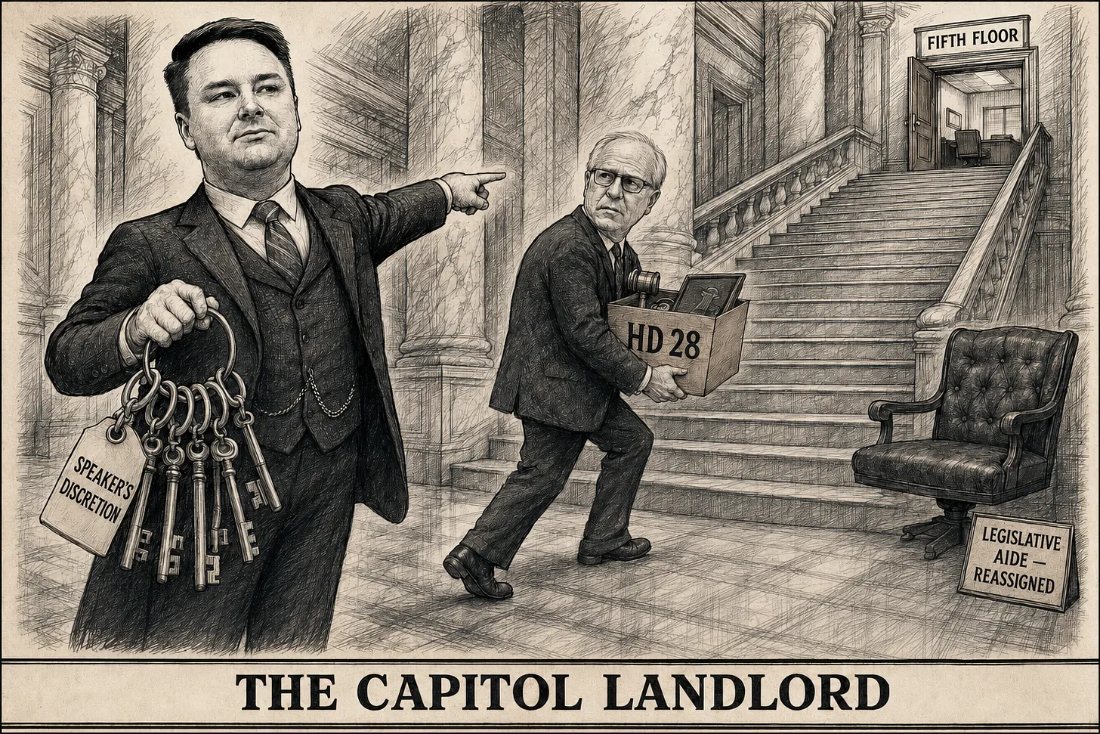
Powerful House Speaker Kyle Hilbert, who represents House District 29, has announced that Williams has been moved out of his fourth-floor Capitol office to a smaller upstairs office, denied access to a legislative assistant and removed from his committee chairmanship—all while facing potential “expulsion” proceedings over allegations of a “very serious nature.”
The findings from Hilbert’s investigation have now been referred to his handpicked Rules Committee chairman, lame-duck Rep. Mike Osburn—known most notably for having an acute case of TDS—to consider disciplinary action that could include expulsion from the House itself, an almost certainly superfluous consideration given the fact that the legislature isn’t even in session and Williams is on the ballot for re-election.
Those are the known facts.
What is not known is nearly everything the voters would need in order to judge whether those actions were warranted.
The specific conduct alleged against Williams has not been made public. The findings of the outside firm’s investigation—conducted at who knows what cost to taxpayers—have not been released. The standard used to evaluate the allegations has not been disclosed. Williams’s response to those findings—if he was even invited to provide one—has not been published. Nor has the public been given a firm timetable for the Rules Committee’s proceedings. In fact, there’s some reason to believe that Williiams may have been instructed by leading house officials, to not discuss the matter in public, a shocking fact, if true.
At first glance—on the sort of superficial read typical of the average social media user—the casual reader will simply offer a tsk-tsk—“the politicians are at it again”—before scrolling on to the next hit of dopamine.
But allow me, for a moment, to posit a patented Jason Murphey reframe:
One state representative—the representative elected by the people of House District 29—has, absent any factual explanation to the public, unilaterally taken away the methods and means by which Williams, the House District 28 state representative, serves his employers: the people of that district.
This occurs during an election cycle as Williams asks his voters to retain him for another term.
The smaller Capitol office is largely symbolic. Taking away the services of a legislative assistant is not. That decision directly diminishes Williams’s ability to communicate with constituents, research their concerns, navigate state agencies and perform the everyday work for which the people of House District 28 elected him.
What gives the representative from District 29 the right to diminish the representation received by the people of District 28 without first providing those citizens with a transparent explanation?
Notably, this comes at a time when Williams is on the ballot for reelection. One can only imagine Williams’s challenge in asking his employers to retain him when a set of publicly undisclosed allegations—of a nature so serious that Oklahoma’s most powerful politician deems him unworthy of accessing his customary Capitol office space—hangs over his head.
And this is the sickness of the House. The secrecy and concentrated power keep its members in a perpetual state of fear. At any point, they could find themselves on the receiving end of retribution from the powerful Speaker of the House, one of his intemperate lieutenants or perhaps his powerful “special advisor, — a position unprecedented in house history” at which point the methods by which they could be targeted are limited only by the imagination.
And that’s the standard joke repeatedly told whenever someone shows the courage not to go along with the Speaker: “Well, I don’t know what he’ll do to me. I guess he can take away my parking space, my office, my legislative assistant, my committee chairmanship and committee memberships, kill all of my bills, and put me against the back wall—but he can’t stop me from voting.”
It is told as a joke because members need a way to cope with or even laugh at the indignity of their situation.
If you have ever asked your state representative why he voted for something inexplicable—why he betrayed the values of his electorate—there is a chance he has quietly explained this system to you as justification for his cowardice. He expected you to understand that independence might cost his district its bills, its committee influence, its staff assistance and its access to the machinery of the House.
The Williams case demonstrates that those threats are not imaginary.
We don’t know what those allegations are, and that’s the problem: we should know.
The constituents of that district should know.
And the accused state representative should be given the opportunity to respond and tell his side of the story, allowing those in that district to decide for themselves well in advance of Election Day.
For every day that unknown allegations are allowed to persist, a disservice is done to those voters.
As for his customary office space and his ability to employ a legislative assistant like other members, are we really to believe that Williams’s normal presence at the Capitol and access to a single legislative aide represent a risk to public safety so severe that both must be denied to him?
If so, then that decision should be made in public, through a public process in which those who make it are held to a meaningful level of accountability.
This is why the House should not be administratively governed as the personal domain of one politician.
The House of Representatives, with its multimillion-dollar annual budget of ever-increasing size and scale, should be governed transparently. It should not be governed by a single politician acting behind closed doors, effectively installed through a secret ballot in a closed-door meeting: the politician, Kyle Hilbert. Instead, it should be governed by a committee of House members elected in a public vote of the institution.
That committee should meet subject to open meetings laws and proper public notice, casting and recording public votes. It should be supported by a professional administrator with the skill set to oversee a large, complex governmental operation—not someone selected merely for political loyalty or a willingness to defer to a political Speaker whose resume suggests that he is in no way, shape or form qualified to oversee an operation of the House’s size and complexity with all of the associated human resource matters such as this one.
The governance committee could still, in a public vote, take action against the representative from House District 28, including removing his office space or staff. But it would do so with the counsel of a professional administrator and under a defensible, clearly articulated standard, ensuring that due process is followed and that the public hears both sides of the matter before action is taken.
And, importantly, the same rules should apply to everyone.
If one of Hilbert’s team engages in the same misuse of state resources alleged against a borderliner, the same investigation, restrictions and potential punishment should follow. Political loyalty should not determine whether conduct is ignored, quietly corrected or publicly converted into an expulsion proceeding (I suspect this particular inconsistency is very likely to reveal itself quite nicely once the specific accusations against Williams become known.)
This is how a professional 21st-century institution should function.
It is what the people of Oklahoma deserve.
And it is especially what the constituents of House District 28 deserve as they prepare to decide whether Danny Williams should continue representing them.
Williams serves at the pleasure of the voters of House District 28.
He does not serve at the pleasure of Kyle Hilbert.


Comments
No comments yet. Be the first to weigh in.
Join the conversation
Sign in with your OSC account to comment on this story and reply to other readers.