"Find Your Guy or Gal": Guthrie City Council Gives It's Approval to Controversial New Surveillance System of Local Citizens
Despite councilmembers’ hesitancy and the concerns of Guthrie City Manager Leroy Alsup, Guthrie Police Chief Don Sweger won approval to use Department of Justice funds for a sole-source contract, paving the way for a new surveillance system across Guthrie.
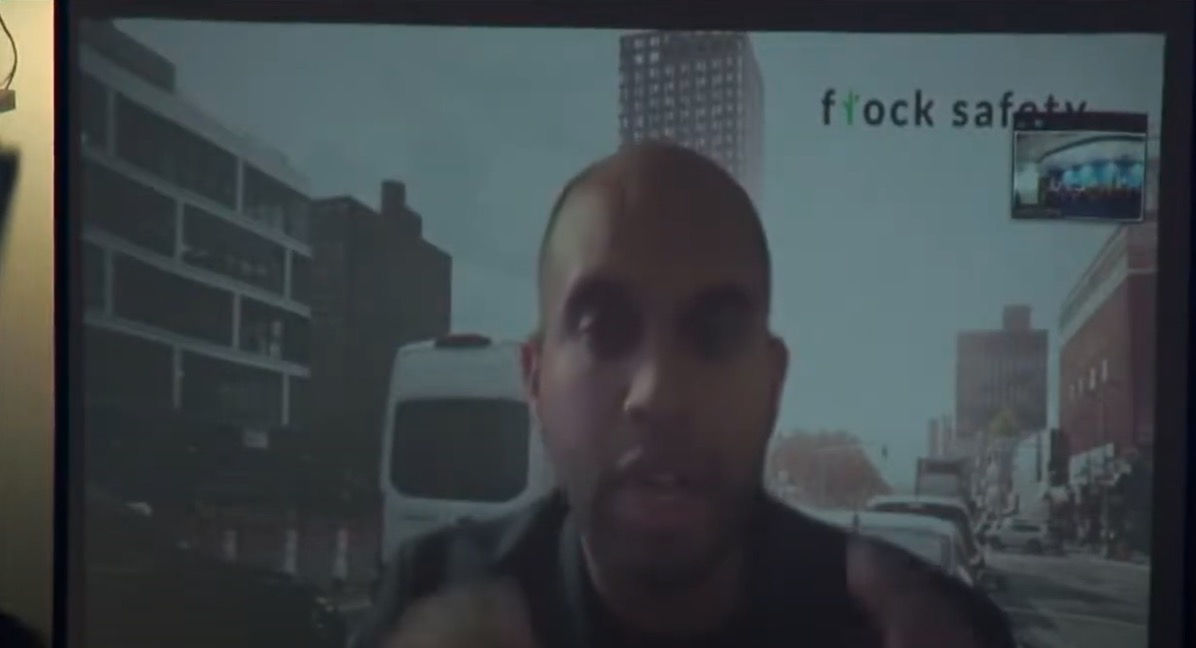
CITY HALL, GUTHRIE, OKLAHOMA — November 15, 2022: In a scene reminiscent of Apple’s “1984” commercial, remote footage of Flock Safety’s Hector Soliman-Valdez towered over council meeting participants as he advocated for the installation of a new surveillance system through a federally funded grant program, sole-sourced to the rapidly expanding Flock Safety.
Listen to this article
Key Takeaways
- The Guthrie City Council unanimously approved a two-year trial of Flock Safety’s ALPR surveillance system, funded by a Department of Justice grant.
- Ward II Councilman Brian Bothroyd described a potential scenario in which the system could trigger door-to-door searches for a “red Honda”.
- Privacy worries and “mission creep” were voiced, with one councilmember likening ALPR to a “gill net” that could ensnare innocent people.
- Despite fiscal and civil liberty questions, the Council cited potential investigative benefits and agreed to approve a two-year trial period.
GUTHRIE, OKLA — After some initial hesitancy, and following a nearly hour-long discussion, Guthrie City Council members on Tuesday signed off on a Department of Justice grant for a two-year trial of a new surveillance technology that one City Councilman envisions will lead police on door-to-door searches through Guthrie until the right “guy or gal” is located.
The technology, as described to the Council by a representative of the security and technology firm Flock Safety, Hector Soliman-Valdez, will place cameras—equipped with machine learning software—alongside Guthrie roads. It will scan each passing vehicle, compare the results against various lists, and allow Guthrie police, and other government agencies, over the course of the ensuing 30 days, to search the logs of passing vehicles.
“I hope nobody has a red Honda in the room,” declared Soliman-Valdez, who then continued to use a red Honda as his example throughout the meeting. He told councilmembers that the company’s machine learning will analyze the Honda logo on a car and combine that with other attributes, such as the license plate number, to create a unique identifier that can be used by police to track the vehicle in its travels.
As he appeared to come to terms with the plan, Ward II Councilman Brian Bothroyd, referring to the “red Honda,” stated, “If you know there’s a red Honda that’s being searched for, you can just search the system for red Hondas and then weed it out potentially by license number or go to all of those residences where that Honda resides if it’s in Guthrie and potentially find your guy or gal.” Guthrie Police Chief Don Sweger appeared to chuckle before confirming Bothroyd’s description: “Right, on the investigative side, correct.”
Sweger explained that Guthrie had learned about the power of the system while working on a missing persons case, where Oklahoma City’s Flock cameras led them to a neighborhood where the missing person was found. He added that the technology would have helped the department solve the Triplett murder case more efficiently. “We had to go on foot to every damn business in town looking for video,” Sweger declared, theorizing that the system would have saved the department 50 man-hours. He also referenced a “dead body at the hospital” where multiple agencies were "fighting" over jurisdiction, suggesting the technology would have saved 30 man-hours and involved the correct agency sooner.
Though he noted some members of the public have privacy concerns with this new approach, Sweger dismissed them, stating, “The only thing it does is it compares it to a hotlist. The hotlist contains stolen vehicles, stolen tags, wanted persons, Amber Alerts, Silver Alerts, Blue Alerts, stuff like that.” Asked whether the technology is in use elsewhere, Sweger indicated that larger Oklahoma cities, including Tulsa and Oklahoma City, already deploy it and that Flock is rapidly expanding across the nation.
Sweger’s plan met hesitation from Ward III Councilmen Tracy Williams and Don Channel, who asked whether the technology would damage Guthrie’s small-town ambiance. “I don’t want to be the guy who brings it to my hometown,” Channel remarked. He likened the technology to a “gill net”: much like a fishing net that indiscriminately catches both intended and unintended targets, Channel suggested ALPR systems could ensnare innocent individuals along with legitimate suspects. While he appreciated the potential law enforcement benefits, he worried about “mission creep”—the gradual expansion of technology beyond its original purpose, potentially affecting people who merely happen to match a suspect vehicle’s description.
Sweger pushed back against Channel’s assertion, stating the plan was not mission creep but exactly what the police department should be doing. He mentioned a transparency portal that would allow the public to gauge the technology’s utility and explained that citizens could choose to opt out of being scanned if they wished. Eventually, Channel agreed to support the two-year trial, telling Soliman-Valdez, “Hector has got two years, and if not, we will kick him to the curb. We will know at the end of that time if it is worth saving or not. So, you got that sermon put together, I warned you.”
Channel’s concerns about mission creep appeared to have validity when Sweger repeatedly theorized about future evolutions of the technology during the meeting. Sweger suggested that if the Council were willing to spend more money, Flock scanners could be disguised as part of streetlight systems at intersections, limiting their visibility. He also pointed out the existence of free scanning software that would allow homeowners to equip their Ring cameras to participate in the scanning.
Ward III Councilman Williams expressed concern as well, stating that he does not believe it is a coincidence that the company calls itself “Flock,” as in a flock of sheep, or that another of its products carries a potentially ominous name, “Talon.”
If you know there’s a red Honda that’s being searched for, you can just search the system for red Hondas and then weed it out potentially by license number or go to all of those residences where that Honda resides if it’s in Guthrie and potentially find your guy or gal. – Brian Bothroyd, Ward II
Meanwhile, City Manager Leroy Allsup voiced worries about the fiscal implications of the DOJ grant provision, “subject to the availability of funding,” fearing the city could find itself liable for Flock’s invoice should grant dollars fail to come through. Sweger said he remained confident in the grant and noted that Flock would provide a “sole source” letter, allowing the city to bypass competitive bidding requirements. He also told the council that Guthrie might qualify for additional state grant funds to pay for the program after the first two years.
Guthrie Mayor Steve Gentling backed the plan, describing it as a “progressive” step and pointing out that “on the surface it appears to be no risk, no cost.” He also noted that citizens regularly post photos of suspicious cars on Facebook, suggesting the Flock system could help streamline that process. Channel, theorizing there could be public pushback, asked if the Council could tell citizens that “the Mayor wanted it,” to which Gentling replied, “Yes.”
Ward II Councilman Bothroyd appeared conflicted for different reasons, at one point saying, “If this just sits there, and no one checks it out, then I am not for it whatever,” referring to potential failures to follow up on hotlist matches. Bothroyd also theorized that the police could use the surveillance data to go door to door in a wide-net search for suspects whose vehicles matched certain criteria—such as a “red Honda”—until they found their target. Sweger seemed to agree with that premise, and Bothroyd, who declared, “If you’re a non-criminal, you have nothing to worry about,” eventually moved to approve the plan. It was seconded by Ward II Councilman Jeff Taylor and passed unanimously by the five council members present.
The Flock system has been heavily criticized by the American Civil Liberties Union (ACLU), which described the company as “a new and rapidly growing surveillance company building a form of mass surveillance unlike any seen before in American life.” The ACLU argues that Flock’s approach effectively enlists customers—both private organizations and police departments—into a centralized government surveillance network and warns that the company aims to expand its offerings to traditional video surveillance and artificial intelligence–based image analysis.
Some of the system's far-reaching capabilities, that have raised the concerns, appear to have been beyond the scope of the Council’s Tuesday night discussion and were only briefly touched upon by Sweger or Soliman-Valdez. Among the features not fully explored was a “custom hotlist” function that allows law enforcement agencies to add a target without due process, bypassing the more stringently regulated NCIC list. Also only lightly addressed was the system’s interconnectivity with other departments—potentially allowing warrantless searches by outside agencies and external users that were not necessarily be bound by Guthrie’s policies and controls.
In October 2022, an example of the alleged misuse of such networked access came to light when a Kechi, Kansas, police lieutenant was arrested for reportedly using the Wichita Flock system to track his estranged wife. On Tuesday, Sweger did not disclose exactly which agencies will have access to Guthrie’s cameras, but he indicated that their identities would be shared through a transparency portal.


Comments
No comments yet. Be the first to weigh in.
Join the conversation
Sign in with your OSC account to comment on this story and reply to other readers.